


Collective Trauma of the Tempi Tragedy and the Psychosocial Impact of Tragic News Coverage
- maribeaux
- Feb 28
- 6 min read

The Tempi tragedy refers to a catastrophic train collision that occurred on February 28, 2023, in Greece, near the town of Tempi, close to Larissa. A passenger train carrying hundreds of people, many of them young students returning from a holiday break, collided head-on with a freight train on the Athens-Thessaloniki railway line. The impact resulted in a devastating fire and led to the deaths of 57 people, with many more injured. Much like how 9/11 exposed security vulnerabilities in the U.S. or how the Columbine shooting forced a national reckoning with gun violence, the Tempi train crash became a brutal wake-up call about the dangers of outdated infrastructure and institutional neglect.
February 28, 2025, marks the second anniversary of this tragedy. To honor the victims and demand accountability, a nationwide 24-hour general strike is planned, expected to halt flights, ferries, public services, and commercial activities. Mass protests are scheduled in over 380 cities worldwide, including 120 international locations.
The phrase "I have no oxygen" has become the motto of the Tempi protests after it was revealed that one of the victims, trapped inside the burning wreckage, sent this heartbreaking final message before suffocating. It quickly turned into a powerful symbol representing not just the literal suffocation of the victims but also the figurative suffocation of Greek citizens under years of corruption, poor infrastructure, and government failures. The slogan captured the public's anger and frustration, much like “I can’t breathe” became a rallying cry in the U.S. following the death of George Floyd, expressing both literal tragedy and a broader fight against systemic injustice.
The tragedy sparked and continues to spark nationwide protests and outrage, as it exposed deep-rooted negligence and mismanagement within Greece’s transportation infrastructure. Citizens and labor unions have taken to the streets for the past two years, blaming both the current and previous governments for ignoring years of warnings about railway safety deficiencies. The government’s response included a public apology and promises for reforms, but for many, the damage was already done. Like other disasters that could have been prevented, such as Fukushima (2011) in Japan, where ignored safety concerns led to nuclear catastrophe, the Tempi train crash became more than just a tragic accident - it became a symbol of systemic failure and a rallying point for demands for better safety measures and accountability.
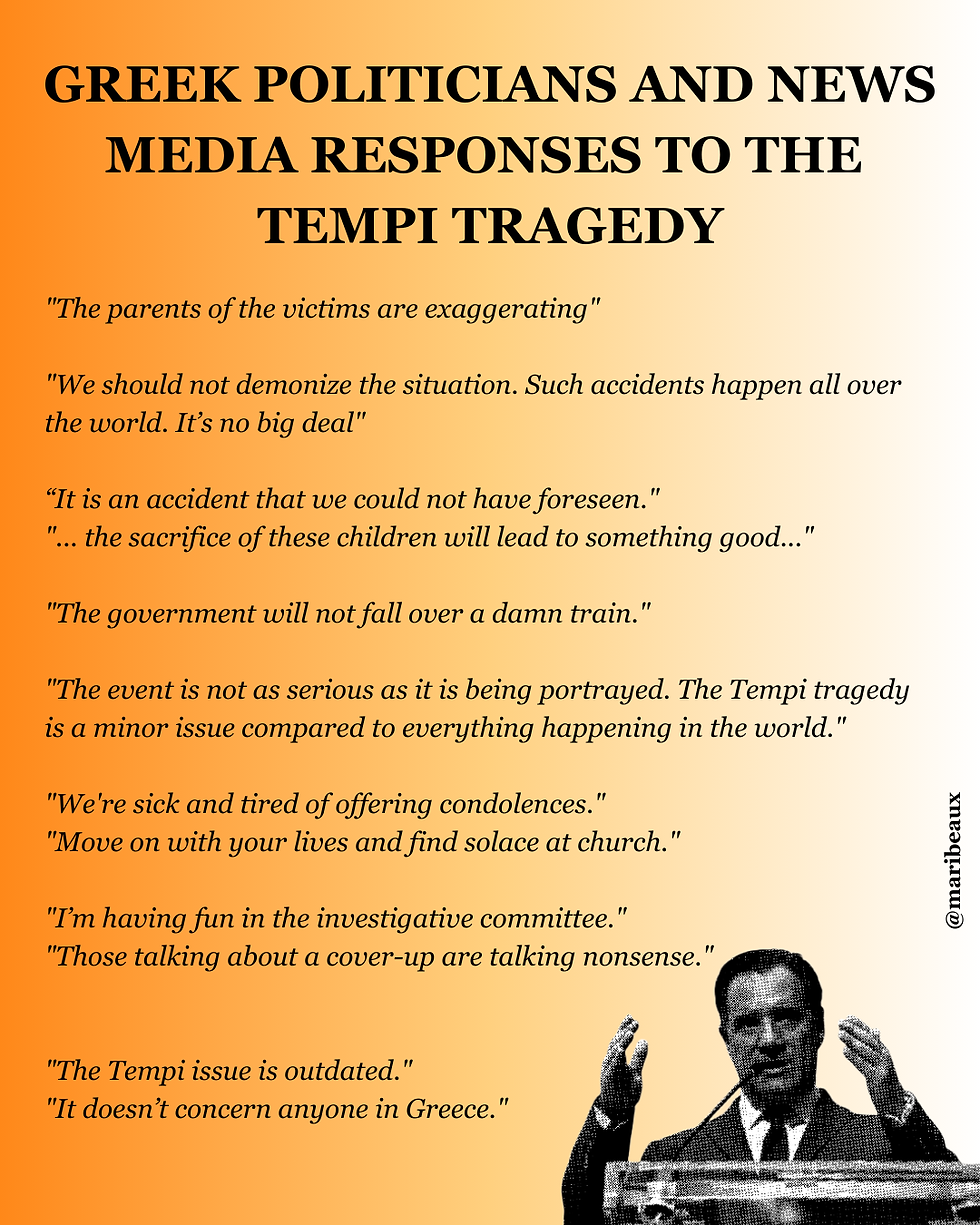
The Tempi train disaster was not an accident—it was a mass killing, a glaring testament to the dismantling of public services, and the corruption of political and economic elites. It was not just a moment of mourning; it was the moment an entire nation stared into the abyss of power’s responsibility and felt the heavy weight of betrayal on its soul.
The collective trauma caused by the Tempi tragedy extends far beyond the survivors and the victims’ families—it permeates the Greek society as a whole, affecting everyone exposed to the images, testimonies, and the endless stream of lies. This is a form of secondary trauma, where even those who were not directly affected experience deep psychological, social, and political consequences.
What Is Collective and Secondary Trauma?
Collective trauma affects a community, social group, or an entire nation that experiences a catastrophic event—be it a natural disaster, war, terrorist attack, or a tragedy like Tempi. It doesn’t just impact those who were directly affected; it also shapes collective memory, culture, and political consciousness. It breeds grief, despair, anger, a sense of injustice, and widespread distrust in institutions, with long-term psychological, social, and political consequences.
Secondary trauma, on the other hand, affects people who did not experience the event firsthand but are deeply impacted by their exposure to it—whether through repeated media coverage or direct interaction with victims and their stories. It often affects journalists, mental health professionals, and social workers, but also ordinary citizens who are repeatedly exposed to harrowing images, videos, reports, and personal accounts of the tragedy.
A person experiencing secondary trauma may suffer from anxiety, emotional numbness, depression, intrusive thoughts, social withdrawal, insomnia, rapid heartbeat, and even symptoms similar to Post-Traumatic Stress Disorder (PTSD).
How Has Collective and Secondary Trauma Manifested in Greek Society After Tempi?
1) Widespread Fear and Avoidance of Public Transportation
According to an Alco poll (02/2025), 81% of citizens believe the government has not taken the necessary steps to make train travel safer since the disaster. Many people, even those with no direct connection to the tragedy, now avoid train travel altogether or feel intense anxiety when they do. There has been a notable increase in car and intercity bus use, as people opt for what they perceive as safer options—even though these alternatives are more expensive. To protect their peace of mind, they are forced to burden their wallets instead.
Public distrust in transportation infrastructure has grown beyond just the railway system. Even in urban transit (buses, metro, tram), people are now more wary, as the Tempi disaster exposed deeper systemic failures and serious safety risks across all public transport networks.
2) Public Outrage, Mass Protests, and Distrust in the Government
According to a Pulse poll (02/2025), 82% of the public considers the Tempi tragedy one of the most pressing issues in the country. A Prorata poll (02/2025) found that 77% of people are dissatisfied with the government’s handling of the investigation. An Alco poll (02/2025) revealed that 72% of citizens believe the government is actively trying to cover up the case.
With no justice for the victims, people are forced to relive the crime daily through media coverage and social media, experiencing a profound emotional weight that has turned into a driving force for resistance. When people feel betrayed and powerless, collective action transforms grief into a demand for change. The protests that followed Tempi have been massive, unlike anything seen in years. They are not just acts of mourning—they are acts of defiance, a refusal to be paralyzed by fear or manipulated by political and economic interests.
3) Pessimism, Learned Helplessness, and Political Disengagement
“What’s the point of protesting?” and “Justice will never be served in this country”—these thoughts have become increasingly common in the aftermath of Tempi. A Prorata poll (02/2025) found that 68% of citizens believe there will never be justice for the victims, while 71% are dissatisfied with the opposition’s response.
The overconsumption of negative news fosters despair and apathy, reinforcing the belief that injustice is the norm and change is impossible. The more people witness tragedies, the more they begin to normalize them, leading to a loss of hope and disengagement from social and political action. This creates a self-fulfilling prophecy: If you believe justice will never come, you won’t fight for it. And if you don’t fight, justice will never come. If you have even a 50% chance of winning, but choose not to fight, that chance drops to zero. Trauma convinces you that the future is already written—that you are powerless to change it.
4) The Bystander Effect and Passive Spectatorship
Some people have become obsessed with the Tempi tragedy, but only as passive spectators—engaging with it as a source of drama rather than a call to action. Picture a simple scene: a car crash on the road, dozens of drivers slowing down just to watch, without any intention of helping.
The same phenomenon occurs with news coverage of tragedies—people have a natural curiosity to witness disaster, consuming it like entertainment, rather than as a moral imperative to act. This is known as the bystander effect—where people passively watch from the sidelines, absorbing human suffering like they would a TV series or reality show.
This happens due to a combination of desensitization and media addiction—the human brain is wired to focus more on threats and dangers, making negative news highly addictive.
From Trauma to Political Awakening
The Tempi tragedy was a turning point. It shattered illusions about safety, governance, and accountability, forcing the Greek public to rethink its relationship with politics, the state, and collective power. But this trauma will not fade away simply because the media moves on to the next disaster, nor because the government tries to sweep it under the rug. As long as justice is denied, the wound remains open.
Protesting after a tragedy is not just about mourning—it is about reclaiming control. Demonstrations foster solidarity, validate grief, and prevent despair from turning inward. They turn pain into action, reinforcing resilience and collective strength.
The real question is not whether a protest alone can deliver justice, but whether inaction will lead to something better. The only true response to the psychological toll of injustice is solidarity and the fight for a world where such tragedies are unthinkable, not inevitable.

Comments